
The Becoming Memoir Series · Book Two — Anchor Summary
- Posted on August 27, 2026
- Book Review
- By Excel Magazine Team
- 331 Views
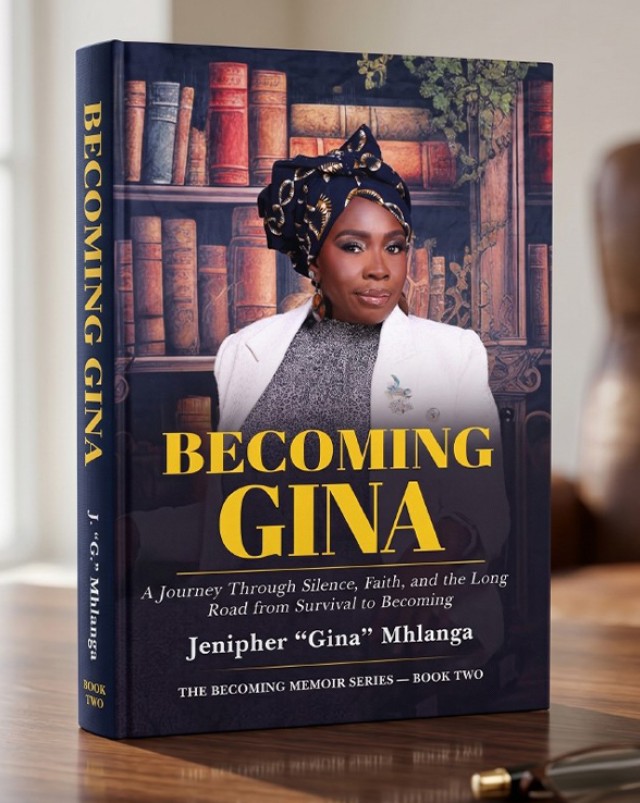
In Becoming Gina, the second book in The Becoming Memoir Series, Jenipher “Gina” Mhlanga takes readers on a deeply personal journey through silence, loss, faith, identity, survival, and healing. Moving beyond the pain of what broke her, she reflects on the experiences that shaped her and the long, often difficult road towards becoming the woman she was meant to be.
Rooted in her Ndebele and Zulu heritage, the memoir traces her journey from childhood and family to grief, marriage, heartbreak, motherhood, and new beginnings. Held together by faith and music, Becoming Gina is a powerful reflection on resilience and the courage to keep moving forward, even when the destination is unclear.
At its heart, it is a story of reclaiming one's voice, identity, and purpose—a reminder that sometimes, you are not lost, late, or failing. You are simply becoming.
BY JENIPHER “GINA” MHLANGA
BY JENIPHER “GINA” MHLANGA
Readers who met Jenipher “Gina” Mhlanga in Enabling Emotional Trauma will remember the God Gap: that sacred interval between what breaks us and who we are becoming, written, as she put it, from inside the middle and not after it. Becoming Gina, the second book in The Becoming Memoir Series, is what the same woman writes once she has walked further down that road, far enough to look back without flinching and forward without fear.
The guiding voice is the one her readers know, calm, faith-held, and culturally rooted, but here it grows surer and wider, no longer speaking only from the pause but tracing the whole long arc that runs through it.
The book opens where the spirit was still being formed, in the uneven rhythms of 2017 to 2021. Ten steps forward: clarity, courage, small victories. Then a hundred steps back. Gina does not rush this season toward resolution; she honors it as sacred time, insisting that God often does His finest work in unfinished spaces.
A summer afternoon in Paris in 2017, where she stood almost by accident as the Tour de France reached its finish, becomes her quiet metaphor: she was standing at the edge of her own race and did not yet know it. Paris, she writes, did not change her. It revealed her.
From that threshold the memoir reaches back to the beginning. In The Foundation we meet the girl they called maNdeti, a child raised not by her absent biological father but by her father’s people, the grandmother and aunts and uncles who claimed her fully as their own.
We meet Roy, the man who fathered her in spirit and believed in the unseen potential of a village girl. We meet a child who sang through everything, who learned early that music could carry what words could not.
And we follow the tender thread of the names she carried, the names given, the names lost, the single name, Gina, stripped from her on an official register while her family name held. The book’s title is its first quiet promise: the reclaiming of a name, and a self.
Then come The Losses. One by one the pillars fall: the great matriarch umaNkomazana; uLady, swallowed by the water well; her grandfather uMlobiseni; her aunt Kellinah.
“Gina renders grief not as spectacle.” But as the slow rearranging of a life, the steady withdrawal of shelter. “This is not your father’s house,” she is told, and learns what it costs to belong nowhere and everywhere at once.
The Cold World is the book’s hardest country. A marriage curdles into what she names Emotional Guns and Roses, love and harm wearing the same face. When it ends, it ends in a courtroom, and Gina refuses the role written for her.
“This is my court,” she declares, gathering a sisterhood whose loyalty becomes its own kind of law. Beneath it all runs her one refusal: she is the woman who must not disappear.
In The Turning, the survivor begins, deliberately, to become. She sells her lobola cows to survive the divorce, a culturally devastating act rendered with startling dignity. She learns discernment, the art of protecting her peace.
She confronts the cycles handed to her, the inherited pattern of enabling, the generational weight of teenage motherhood, with a resolve unforgettable in its plainness: stop the bleeding, then end the cycle.
And she names the ache hidden inside every rise, the loneliness of elevation, of being seen for the arrival and never for the cost.
The final movement, Becoming, is quieter and somehow larger. Gina discovers the beauty of building in silence, guarding her dreams from the wrong ears, rising before dawn to write, leaning on the steady community of the Round Table.
She crosses an ocean. In Chicago and there she meets the diaspora’s particular loneliness and its particular grace: the cold, the winter swimmers, the strange freedom of being unknown.
And she arrives, at last, as the unhurried woman, no longer bracing for impact, no longer late, no longer failing. Simply becoming.
Two ropes hold her through every fall: faith and song. She is, before anything else, a girl who sang through everything, whose belief never required the storm to stop before she could worship inside it.
The music is literal, the Ndebele and Zulu songs that score weddings and farewells, and also a posture: the refusal to let grief have the last note.
What makes Becoming Gina remarkable is the voice that carries it. Faith here is never loud; it is presence, the steady awareness of God holding space when answers stay delayed.
Becoming too, is rarely loud; at times it is only persistence, showing up tired but willing. Yet where the first book spoke in hushed, single notes, this one moves in full chords, awareness, faith, humor, loss, and battered forward motion mixed into every chapter, what Gina calls a cocktail, not a recipe.
Her Ndebele and Zulu inheritance is not decoration but the bloodstream of the book: uGogo, lobola, the wedding songs sung over and over, the grandmother who paid a bride price on behalf of an absent son.
It is a story specific enough to belong to one woman and the village that raised her, and universal enough to belong to anyone who has ever silenced herself to keep the peace.
Readers who hold Trevor Noah’s Born a Crime close, its Southern African weave of mother, faith, and humor carried through hardship, will feel at home in these pages, alongside lovers of the culturally rooted storytelling of Chimamanda Ngozi Adichie and Edwidge Danticat.
It is, finally, a memoir about trauma that is not about trauma at all, but about a birthright. “I was not lost,” Gina writes. “I was not late. I was not failing. I was becoming.”
In Enabling Emotional Trauma she wrote from inside the pause God was holding. In Becoming Gina, she writes as a woman who has felt that pause break open into a life, and who has found, at last, the unhurried voice to tell it.